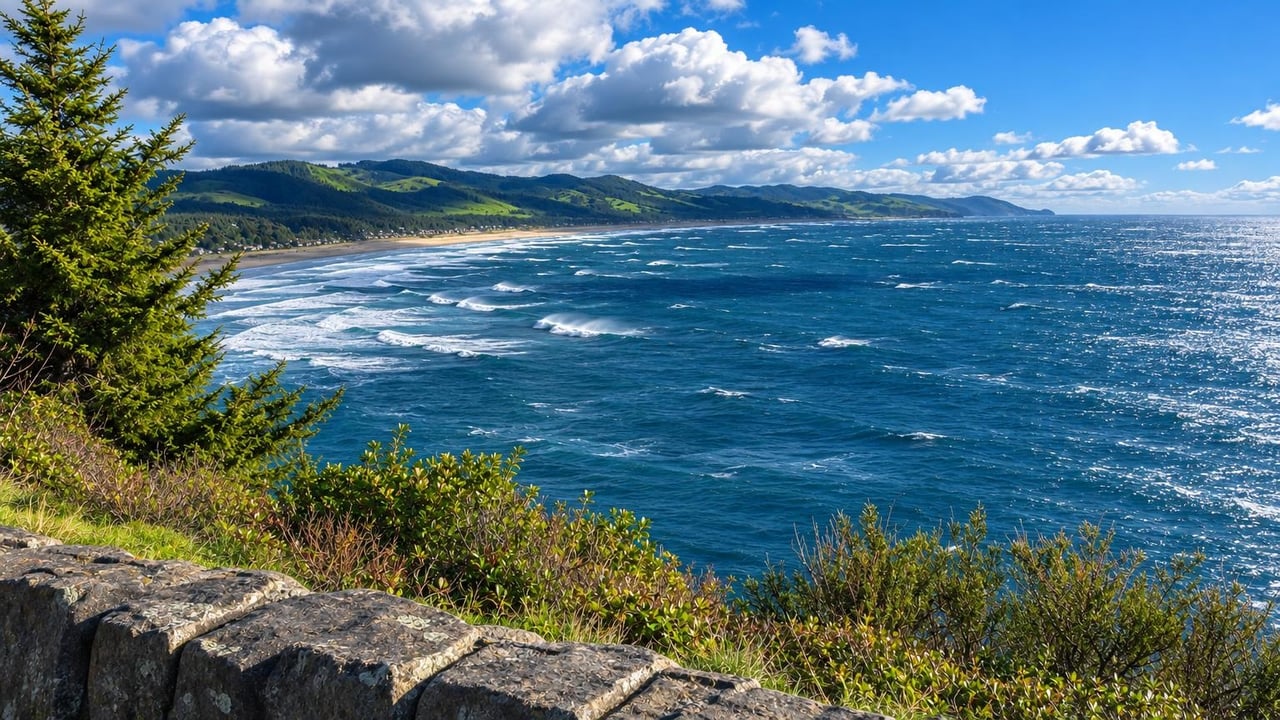
Whale Watch Week at the Neahkahnie Mountain Overlook
November 26, 2026
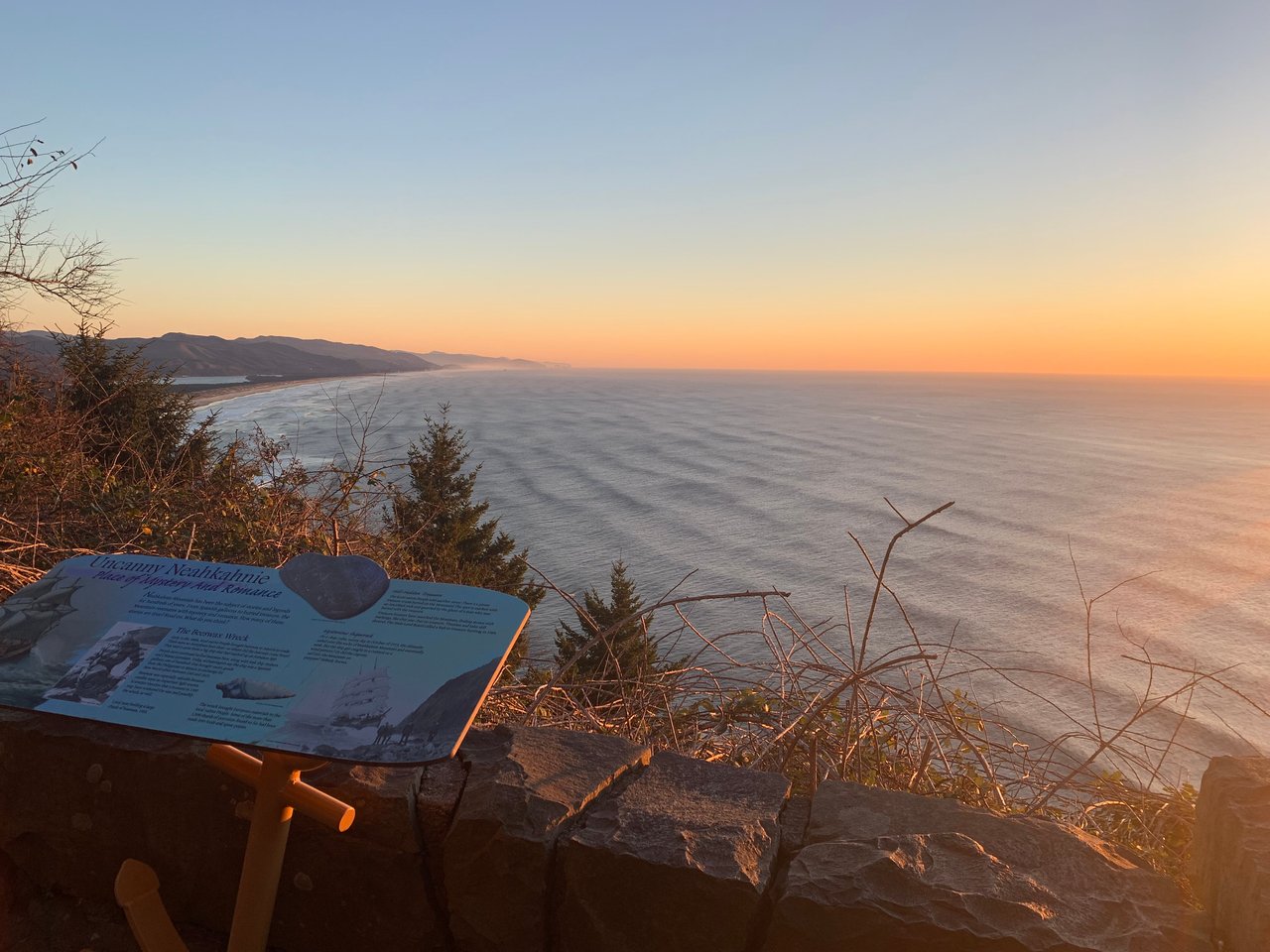
Highway 101 climbs the seaward face of Neahkahnie Mountain on a ledge cut out of the rock. A low stone wall runs along its outer edge. The highway opened over the headland in 1940. It was the last piece of the Oregon Coast Highway, and it replaced a much longer inland road. Crews from the Works Progress Administration built that wall in the rustic rockwork typical of WPA projects, as a safety feature that also kept the view open to drivers. The engineers placed the turnouts to fit the shape of the mountain so drivers could stop and take in the view. The Oregon History Project notes that the route follows an old trail that once linked the Clatsop and Tillamook peoples.
That wall gets its busiest use of the year in the week after Christmas. From Sunday, December 27, through Thursday, December 31, 2026, volunteers with the Oregon Whale Watch program will be at the Neahkahnie Mountain Overlook every morning to help people find the gray whales heading south. The timing works well if you live in Manzanita, Neahkahnie or anywhere up toward Cannon Beach, because the southbound migration is near its peak and the nearest staffed site is a short drive up the hill.
Each staffed site runs from 10 a.m. to 1 p.m., according to Oregon Whale Watch. Most days a site has between two and eight volunteers. They set up a Whale Watch sign and bring a small tote of teaching materials: whale models, flyers, and a rope cut to the length of a gray whale. Laid along the wall, the rope shows how far one animal would reach. When the shift ends at 1 p.m., the volunteers file a report with that day's count of whales and visitors.
Oregon State Parks places volunteers at 15 sites along the coast during each Whale Watch Week. On the program's site map, the North Coast has three: Fort Stevens State Park at the Peter Iredale shipwreck, the Neahkahnie Mountain Overlook, and Cape Meares Lighthouse. That makes Neahkahnie the only staffed site on the program's map between the mouth of the Columbia and Cape Meares. For Manzanita and the Nehalem Bay communities, it is the staffed site right next door. The same map ran in The Astorian's coverage of last December's Whale Watch Week, which also ran December 27 to 31. Oregon State Parks keeps the current site list on its whale-watching page, so give it a quick look before you drive up.
The dates come from a count made in 1978. That year, Don Giles of Hatfield Marine Science Center in Newport went out to Yaquina Head Lighthouse with his binoculars. His colleagues Bruce Mate and Denise Herzing were already counting gray whales there. Their numbers showed two peaks in the migration along the Oregon coast. The southbound peak falls in the winter holidays, and one of two northbound peaks comes near the end of March. Giles turned that finding into the Whale Watching Spoken Here program. The 2026–27 schedule keeps the same pattern, with winter week December 27 to 31 and spring week March 20 to 28, 2027.
Oregon State Parks gives mid-December through mid-January as the main window for southbound whales. During that month, thousands of gray whales pass on their way to the lagoons of Baja California. Oregon Whale Watch puts the general peak rate for the Oregon coast as a whole at about 30 whales an hour. Summer is very different. Oregon State Parks says about 200 gray whales stay in Oregon waters to feed during the warm months, and it calls the central coast a hot spot for them from June to mid-November. So in December you're watching the migration itself pass the North Coast, which is a much bigger group than the summer feeders.
As OPB reported in The Astorian last December, the whales are traveling from summer feeding grounds off Alaska to Mexico's lagoons to give birth. Watchers can see their spouts and sometimes feeding behavior such as headstands, upside-down swimming and bubble blasts. From the wall, a spout is usually the first thing you'll see. The volunteers are trained by local researchers and Oregon State Parks interpretive rangers to locate and identify the marine mammals of the Oregon coast.
The southbound whales passing Neahkahnie this December are the same population NOAA Fisheries counts from shore in California. NOAA's latest numbers drew attention. In July 2026, scientists at the Southwest Fisheries Science Center estimated the Eastern North Pacific gray whale population at about 17,750 for the 2025–26 survey season, within a range of 15,930 to 20,530. The 2024–25 estimate had been about 12,890, one of the lowest since counting began in the late 1960s. For a longer baseline, the population peaked at about 27,000 whales in 2015–16. NOAA then declared an unusual mortality event for elevated strandings from 2019 to 2023.
NOAA called the increase welcome news and, in the same write-up, raised questions about it. The agency says the increase in a single year probably exceeds what the population could produce through births. NOAA estimated 85 gray whale calves in 2025, the lowest on record. Researchers are now looking at whether migration timing and the assumptions behind the count have changed. In NOAA's own write-up of the new estimate, research scientist Aimee Lang put it this way: "We know that we don't see every whale." NOAA also reports that strandings over the past two years have climbed back into the range seen during the mortality event, though they don't yet meet the criteria for a new one.
The volunteer tallies from Neahkahnie and the other 14 sites are a separate count from NOAA's survey. They're still a daily record of what passed one stretch of the Oregon coast in late December. This year, that's a stretch of a migration scientists are examining more closely than usual. NOAA keeps its current estimates on its gray whale population page.
The roadside pullouts sit on the seaward face of the mountain, north of Manzanita, between the turnoff for Neahkahnie Beach and Oswald West State Park. A Highway 101 milepost guide puts the viewpoints around mileposts 40 and 41. The Oregon Hikers field guide describes the stretch in order from south to north. One pullout has a path running beside the 1930s stone wall. Another pullout is at milepost 41. The last pullout, where the stone wall ends, has an interpretive display. Look for the Whale Watch sign along the wall when you pull in.
The highway here was carved out of the cliff face, and the slope below it drops almost sheer through manzanita and spruce. With several pullouts strung along the stretch, if one is full on a clear holiday morning, there is another one a short way along the wall.
The roadside wall is a different spot from the summit viewpoint on the trail. The rocky summit looks south over Neahkahnie Beach and Manzanita to the mouth of Nehalem Bay. It's a fine winter outing on a dry day, but nobody staffs it with spotters. Our August piece on how the Neahkahnie trails changed covers the three trailheads and the missing Necarney Creek bridge. For a whale morning with guests, the wall is the easier stop. You park, walk a few steps, and someone with binoculars points you to the spout.
One other bit of mountain lore often comes up at the turnouts: the buried Spanish galleon treasure. Tillamook Coast's guide to Neahkahnie Mountain calls it folklore and says there's no reliable evidence anyone has found it.
The shift times make the plan simple. Arrive at the wall between 10 a.m. and 1 p.m., when the volunteers are counting. Then drive down into Manzanita for lunch on Laneda Avenue. Five mornings in a row give you room to wait out a squall, since a rainy Monday can be followed by a clear Tuesday. If you miss this week, the spring week runs March 20 to 28, 2027, when the whales head north. If spotting whales from the wall turns into a regular habit, Oregon Whale Watch trains new volunteers twice a year. Volunteers sign up for at least two days per Whale Watch Week.
If a morning at the wall has you picturing a place in Neahkahnie or down in Manzanita that looks out over the same water, Andrea Mace and the Mace Team would be glad to talk it through. Schedule your concierge consultation.
Super El Niño Will make these King Tides even Bigger
A small town with lots of culture and things to do
Oregon's Coastal Highway was once the Beach
The City of Cannon Beach is phasing out 30+ permits
Are you looking for a Unicorn? Let Andrea Mace help you.
Want to sell now or in the future? Let's start a conversation about how my services can be put to use to market and sell your home to a qualified buyer.